


Key takeaways
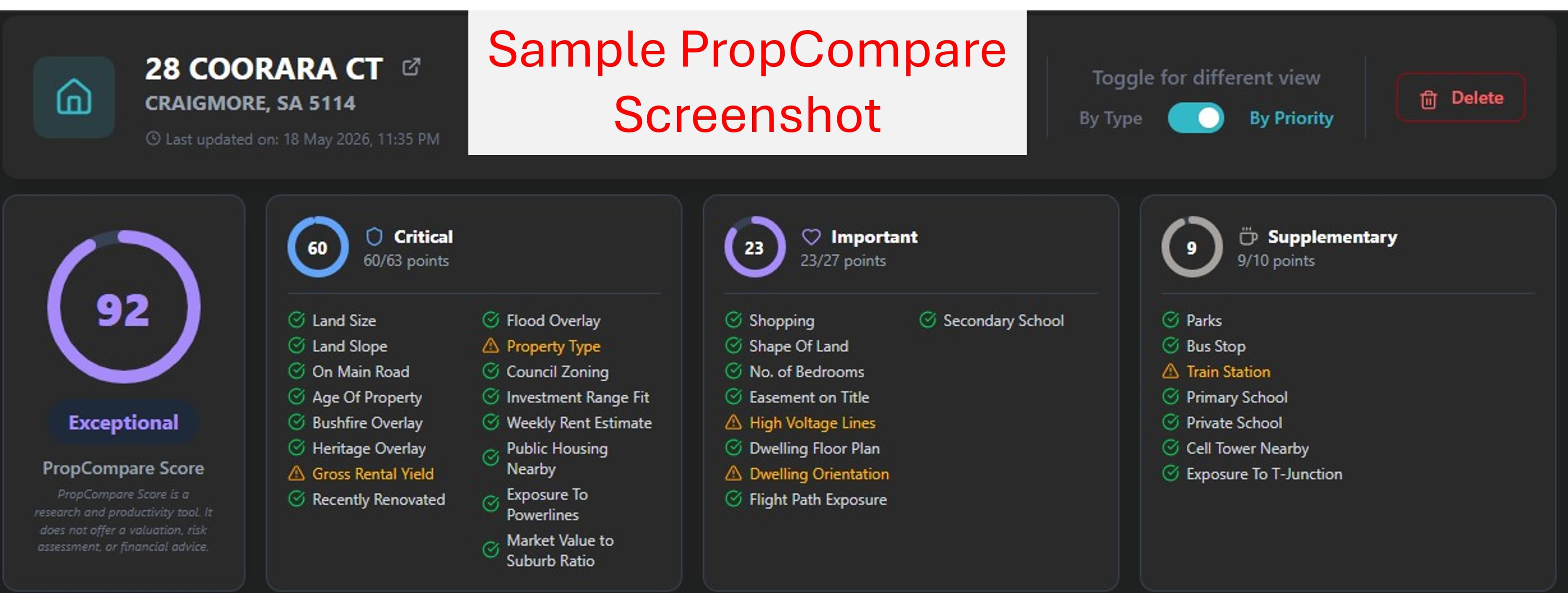
- The PropCompare Score is a single 0 to 100 number built from 30 separate factors, so any two Australian addresses can be compared on the same scale.
- It is split into six plain-English bands, from Poor to Exceptional, so you can sort a shortlist at a glance before reading any detail.
- The 30 factors sit in three weighted tiers. Critical factors carry 63 of the 100 points, important factors 27, and supplementary factors 10.
- The Score is a research accelerant, not a verdict. It tells you where to spend your attention. It does not replace an inspection, a contract review or professional advice.
What the PropCompare Score is
When you analyse an address in PropCompare, the platform returns one number between 0 and 100. That number is the PropCompare Score.
Behind it sit 30 individual factors: flood and bushfire overlays, council zoning, land slope, heritage, the price against the suburb median, orientation, school and transport proximity, flight path exposure, and the rest. Each factor is assessed, scored, weighted and rolled into the single headline number.
The point of compressing 30 things into one is comparison. A flood overlay in one suburb and a steep block in another are not the same kind of problem, and a buyer cannot hold all 30 factors for six different properties in their head at once. One number on one scale makes six properties directly comparable in the time it takes to read a list.
Why a single number helps
A shortlist usually starts as a mess: tabs open, agents calling, a spreadsheet half-filled, six addresses that all look fine in the photos. The Score does not tell you which one to buy. It does something more useful at that stage. It turns the mess into a plan.
In practice, the Score lets you make four decisions quickly:
- Which to focus on. The high scorers are where your limited weekend inspection time is best spent.
- Which to research deeper. A middle score is rarely "average everything". It is usually strong on some factors and weak on others. That is a signal to open the breakdown, not to discard the property.
- Which to deprioritise. A low score across many factors is the market and the data agreeing. It is permission to stop spending time there.
- Which to compare like with like. Two properties in different suburbs, different price points, different problems, on one scale. That is the level playing field a shortlist needs and rarely has.
Few tools turn this many factors into one comparable number for a residential buyer, and fewer do it in the few minutes an address analysis takes rather than the hours of manual portal-hopping it replaces. That speed is the point. The Score is most valuable early, when you have too many options and not enough time.
The six bands and what they mean
The 0 to 100 Score is grouped into six plain-English bands. You do not need to memorise the cut-offs. The band name does the work at a glance, and the colour reinforces it on the property card and the comparison table.
The bars show the share of this metric's maximum points awarded for each band.
A band is a triage tool, not a judgement on whether a specific property suits you. A "Good" property with a flaw you can live with may be a better buy for you than a "Strong" one with a flaw you cannot. The band gets you to that conversation faster. It does not have it for you.
What sits behind the number: the three tiers
The 30 factors are not weighted equally. They sit in three tiers, and the tier decides how much each factor moves the Score.
| Tier A: Critical | Tier B: Important | Tier C: Supplementary | |
|---|---|---|---|
| Share of the Score | 63 of 100 points | 27 of 100 points | 10 of 100 points |
| Number of factors | 14 | 9 | 7 |
| What it covers | Flood, bushfire, zoning, slope, heritage, price vs suburb median | Orientation, secondary school proximity, flight path, land shape | Parks, bus and train proximity, cell towers, T-junctions |
| Why weighted this way | Hard or impossible to change, large dollar impact, can sink a deal | Shapes liveability and buyer demand over time | Nice to have, rarely decisive on its own |
The logic is straightforward. A Critical factor is something you usually cannot fix and that has a large, lasting effect on value or risk: you cannot move a house out of a flood overlay or off a steep block. A Supplementary factor is real but minor and often substitutable: a slightly longer walk to the bus is not in the same universe as a 1-in-100-year flood line. Weighting Critical factors at roughly six times Supplementary factors keeps the headline number honest about what actually matters.
This is also why the breakdown matters as much as the headline. Two properties can both score 68 ("Good"). One earned it with solid Critical factors and weak Supplementary ones. The other scraped it with good amenity but a Tier A risk flag. Those are very different properties with the same number. The Score gets you to look. The tiers tell you where.
Where the underlying data comes from
A score is only as good as the inputs. PropCompare draws each factor from the most authoritative source available for that factor, where coverage exists:
- Government planning and spatial data for flood, bushfire, zoning and heritage overlays.
- Elevation and terrain data for land slope.
- Mapping and proximity data for schools, transport, parks and other amenities.
- AI visual analysis of aerial and street-level imagery for factors like powerlines, main-road exposure and orientation.
- User-provided inputs for the figures only you can supply, such as a property's market value and the suburb median, which the platform then scores.
Sources span free public data, authoritative government datasets and paid commercial data. The full provider list is published on the data attribution page. Coverage and currency vary by state and data type, which is why the Score is described as a research accelerant rather than a guarantee. The value is doing in minutes what would otherwise take hours of checking flood maps, zoning portals, school catchments and council records one property at a time.
A score is a starting point, not a verdict
This matters enough to say plainly. The PropCompare Score is a productivity and research tool. It is not a valuation, not a risk certification, and not financial or investment advice.
A high Score does not mean a property is a good investment for you. Your budget, your strategy, your timeline and your tolerance for a particular trade-off are not in the number. A low Score does not always mean walk away. Sometimes it means negotiate, or it means the property suits a plan the median buyer does not have.
Use the Score to decide where to spend your attention. Then do the things the Score cannot do: walk the property, read the contract and the title, get a building and pest inspection, and take advice from a licensed professional before you commit.
How to actually use it on a shortlist
The practical workflow most buyers settle into:
- Analyse every address on the shortlist. A few minutes each.
- Sort by Score. The list reorders itself into a rough priority for the first time.
- Open the breakdown on anything in Good or above. Confirm the points came from the Tier A factors you care about, not just easy amenity points.
- Check the Tier A factors on the middle scorers. A 60 with clean Critical factors and weak Supplementary ones can be a better buy than a 70 with a flood flag.
- Stop spending time on the persistent low scorers. Multiple weak Critical factors is the data telling you the same thing the market eventually will.
- Take the survivors to the real-world steps. Inspection, contract, advice. The Score got you here faster. It does not finish the job.
Frequently asked questions
Related reading
 PropCompare feature
Negative gearing is changing in 2027. Here is how to see what it does to your numbers.
The 2026-27 Budget limits negative gearing to new builds from 1 July 2027. A plain-English explainer, and a free calculator that models the change on your numbers.
 Critical property factor
Should you buy the worst house on the best street?
Australian property advice has said it for decades: buy the worst house on the best street. The number behind the rule, and when it actually works.
 Critical property factor
Flood zones in Australia: what every property buyer should know
Flood-zone homes trade at around an 8.5% discount and lag the market for years. Here is what every Australian buyer should weigh before making an offer.