


Key takeaways
- Aircraft noise in Australia is mapped using ANEF, the Australian Noise Exposure Forecast. ANEF rolls a whole year of flights into one average number, so even a low ANEF cannot promise that a single early-morning jet will not wake you.
- Peer-reviewed Australian studies put the discount at roughly 10 to 17% for homes meaningfully inside a flight path, and the discount is effectively permanent because the infrastructure is permanent.
- The most comprehensive long-term Australian study (Brisbane, 1988 to 2020) found a real exception: well-located suburbs under flight paths still out-performed poorly-located suburbs with no aircraft noise.
- A home can sit outside the official 20 ANEF contour and still be woken by an early-morning freighter. The contour answers a yearly-average question, not a single-event one.
What "flight path exposure" actually means
Every major Australian airport has a forecast map of how much aircraft noise the surrounding land is expected to receive. That map is built from contours.
The contours are labelled 20, 25, 30, 35 and 40. A higher number means more forecast noise. Under the Australian Standard for aircraft noise (AS 2021), new residential development is generally only considered acceptable outside the 20 ANEF contour. Inside it, building rules tighten and, deeper in, residential use is discouraged or conditioned.
Two things are worth understanding straight away.
First, ANEF is not decibels. It is a yearly index that blends how loud each aircraft is, how often they come over, and the time of day they do it. You cannot stand in a backyard with a sound meter and read off an ANEF number.
Second, ANEF is a forecast, not a measurement of the past. It is built around expected future operations: more flights, bigger aircraft, new runways. The official chart is the one Airservices Australia has endorsed for technical accuracy, which is the version planning authorities use.
Why a low ANEF does not always mean quiet
This is the detail most buyers misunderstand, so it is worth being precise about it.
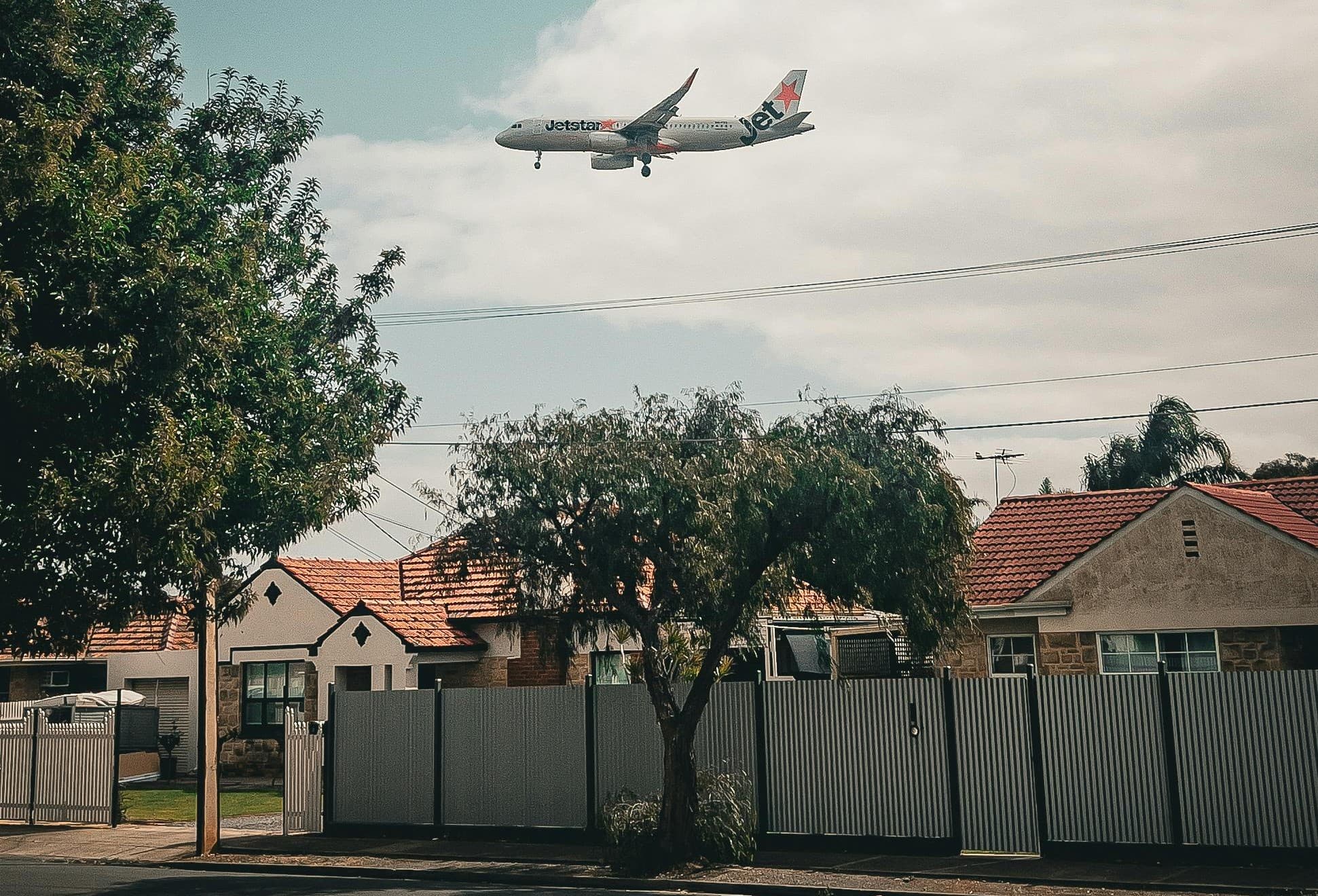
A property outside the 20 ANEF contour is, on the annual-average measure, lightly exposed. That does not mean it is quiet at 5am when a freight aircraft climbs out over the roof. The contour answers the question "how much aircraft noise will this area get across a whole year on average". It does not answer "will a single departure rattle my bedroom window tonight".
This is why airports and aviation authorities also publish event-based information: how many times a night an area gets an event above a given loudness, and which runways and flight paths are in use under different wind and operational conditions. Many airports also run runway rotation or respite programs that move the noise around through the week. The practical takeaway: read the ANEF for the long-term picture, then check the actual flight paths and the time-of-day pattern for the lived reality. They are two different questions.
What the research actually shows
The price impact of aircraft noise has been studied carefully in Australia, and the findings are consistent enough to plan around.
Sources: peer-reviewed Australian hedonic-pricing studies. Adelaide Airport research (Burns et al.) found homes at 25 ANEF or higher priced about 10.7% lower than comparable homes outside the 25 contour, rising to around 20.8% where day-night noise reached 70 to 75 decibels. A 2020 Cairns Airport study found roughly a 17% discount for homes directly under the flight path. An Essendon Airport study found prices rose about 11% for every kilometre away from the runway.
A few patterns hold across the studies. The discount only becomes clearly measurable once exposure is real (around the 25 ANEF mark and above), not at the faintest edge of the map. It scales with intensity: the deeper into the contours, the larger the discount. And it is durable. Flight paths are fixed infrastructure, so unlike a cosmetic problem you can renovate away, the discount tends to persist for as long as you own the home.
The Brisbane exception: when location beats the discount
Here is the part that complicates the simple "avoid flight paths" advice.
The most comprehensive long-term Australian study of aircraft noise and residential value (Professor Chris Eves of RMIT and Dr Andrea Blake of QUT, analysing Brisbane sales from 1988 to 2020, considered one of the most thorough of its kind globally) found the expected discount, but also something important alongside it. Suburbs under the established Brisbane flight paths that sat in well-located inner and middle-ring positions still delivered higher average annual capital returns than less well-located Brisbane suburbs with no aircraft noise at all.
The reading is not "aircraft noise does not matter". It clearly does, and the discount is real. The reading is that aircraft noise is one factor among many, and a genuinely strong location (jobs, transport, schools, scarcity of land) can do more for long-term value than the noise takes away. A flight-path home in a premium inner suburb and a quiet home in a poorly-located outer suburb are not a simple ranking.
Grace and Sam: same suburb, one under the path
Grace and Sam are looking in the same well-located middle-ring suburb near a capital-city airport. Grace's preferred home sits just inside the 25 ANEF contour, under a regular departure path. Sam's, a few streets across, sits outside the 20 contour.
| Grace (inside 25 ANEF) | Sam (outside 20 ANEF) | |
|---|---|---|
| Purchase price versus suburb | ~ 10 to 15% below comparable | Around suburb level |
| Lived noise | Regular daytime events, some early movements | Occasional, weather and runway dependent |
| Discount over time | Permanent; the flight path does not move | Minimal |
| Long-term capital growth | Driven by the strong location, dragged a little by noise | Driven by the strong location |
| Buyer pool at resale | Narrower; noise-sensitive buyers screen it out | Broad |
| Net position | Cheaper entry, real noise trade-off, location still works | Pays full price for the same location, no noise trade-off |
Grace buys the same location for less and accepts a permanent, real noise trade-off. Sam pays the location's full price and avoids the trade-off. Which is the better buy depends on noise tolerance, how long they will hold, and how much of the discount the strong location quietly hands back over a long ownership. There is no universal right answer, which is exactly why it should be a deliberate decision.
Beyond the price tag
Three things the discount figure does not capture.
1. Sleep and health
The World Health Organization's Environmental Noise Guidelines treat aircraft noise as a health issue, not just an amenity one, with effects on sleep and stress that begin well below the loudest contours. Early-morning and late-night movements matter more for wellbeing than the raw daily count, which is why the time-of-day pattern is worth checking, not just the ANEF number.
2. The discount is permanent
You can renovate a tired kitchen. You cannot renovate a flight path. Unlike many property issues, the aircraft-noise discount does not close over time through your own effort. It is priced in when you buy and priced in again when you sell.
3. Flight paths can change
ANEF is a forecast of future operations, and operations change. New runways, new procedures, growth in freight and changes to flight paths can move noise onto areas that were previously lightly exposed, or off areas that were heavily exposed. A property at the edge of a contour today is making a small bet on what the operations look like in a decade. Major airport redesigns around Australia have repeatedly shifted which suburbs carry the noise.
Common misconceptions
- "Outside the 20 ANEF contour means it is quiet." No. The contour is a yearly average. A home outside it can still get woken by individual early-morning or late-night aircraft. Check the actual flight paths and the time-of-day pattern, not just the contour.
- "ANEF is a decibel reading." No. It is a cumulative annual index that blends loudness, frequency and time of day. It does not correspond to a single sound-meter number.
- "The discount will disappear as people get used to it." It does not. The studies show it persists because the infrastructure is permanent. Habituation does not remove a market-priced discount.
- "A flight-path home is always a bad investment." Not according to the most comprehensive Australian study. A strong location can out-perform a weak one even with the noise. The discount is a reason to negotiate, not always a reason to walk.
- "The flight path will never change." It can. Airport growth and procedure changes shift flight paths over time. Treat the current ANEF as today's picture, not a permanent guarantee.
Frequently asked questions
Related reading
 Critical property factor
Is buying on a main road ever a good idea?
A 6% price discount per 10 decibels of traffic noise. Here is the honest case for and against buying a property on an Australian main road, and how to check if a road counts.
 Critical property factor
Are powerlines actually bad for your property?
ARPANSA says no established health risk. Australian valuers price a 3 to 10% discount anyway. The gap between what the science says and what the market does.
 Critical property factor
Should you buy the worst house on the best street?
Australian property advice has said it for decades: buy the worst house on the best street. The number behind the rule, and when it actually works.